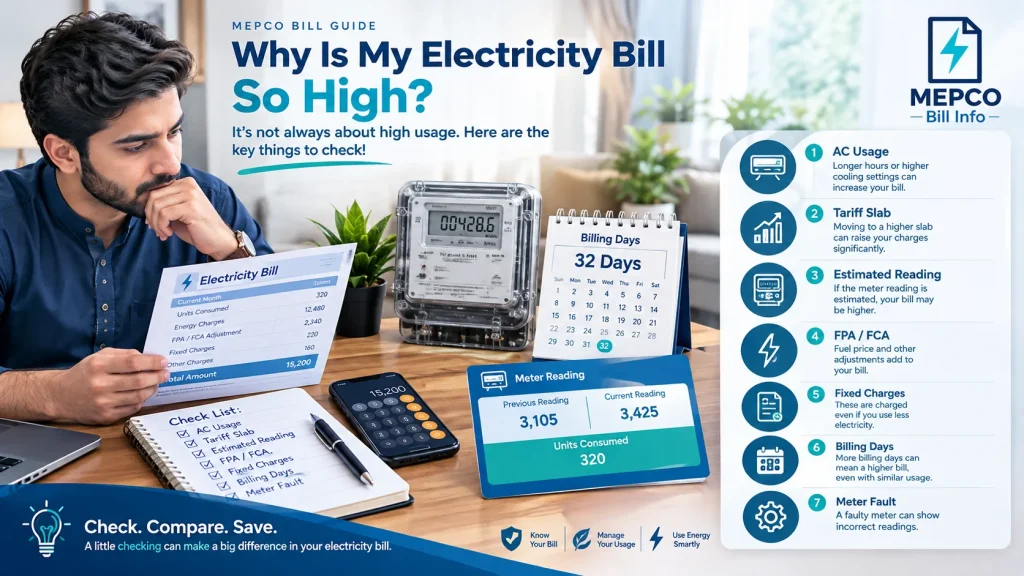
If you’re wondering why is my MEPCO bill high, start by comparing this month’s units, meter reading dates and bill period with last month’s bill. A higher bill isn’t always caused by higher electricity use; slab changes, estimated readings, adjustments, fixed charges, a longer billing period or a faulty meter can also push the amount up.
Table of Contents
Your AC Used More Electricity Than You Realized
Summer is one of the most common reasons for a sudden increase in MEPCO bills. An air conditioner can consume several hundred units over a month depending on its capacity, temperature setting, running hours and efficiency.
For example, a 1.5-ton AC drawing roughly 1.2–1.8 kW while operating for 8 hours a day could use around 288–432 kWh in a 30-day month if it ran continuously at that average load.
That’s before adding refrigerators, water pumps, fans, irons and other appliances.
The important number on your bill is Total Units Consumed. Compare it with the previous two or three bills rather than looking only at the rupee amount.
If your consumption went from 180 units to 300 units, the increase isn’t simply 120 units of electricity. Moving into a different tariff slab can also change the applicable rate.
Sound familiar? Check the units first.
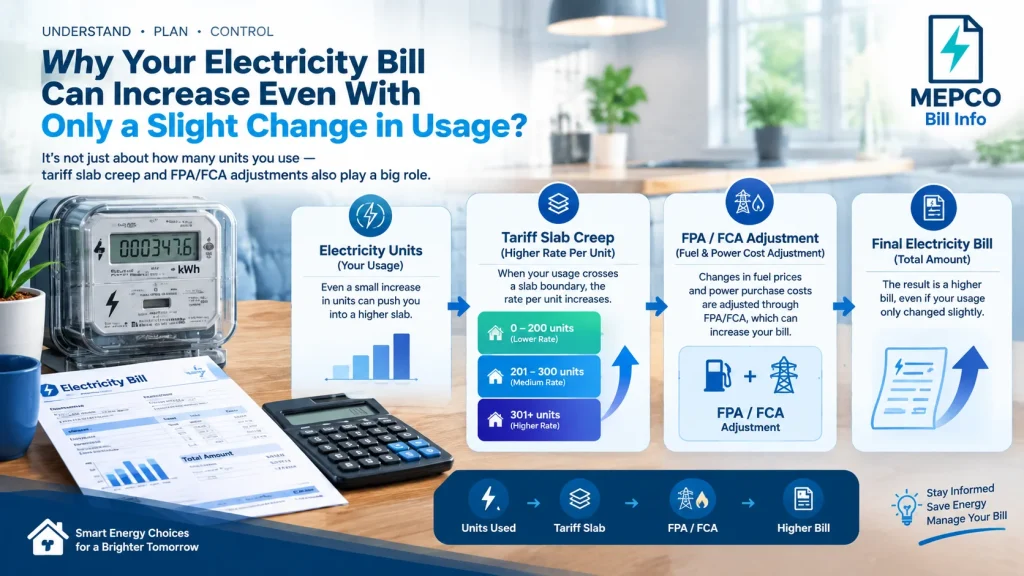
You Crossed Into a Higher Tariff Slab
This is the classic slab creep problem.
Electricity tariffs are structured around consumption levels, so crossing a threshold can make the additional units more expensive. The exact rates depend on the applicable MEPCO tariff notified for your consumer category and billing period. NEPRA’s MEPCO tariff schedules show different rates for different residential consumption ranges.
Suppose your household normally stays around a lower consumption band but this month your AC use pushes you above the next threshold. Your bill may rise by more than you’d expect from the extra units alone.
That’s why comparing only:
Previous bill = Rs. X
Current bill = Rs. Y
isn’t enough.
Compare:
- Previous units
- Current units
- Previous slab/category
- Current slab/category
- Variable electricity charges
- Taxes and adjustments
For the current applicable rates and slab structure, check our MEPCO tariff rates guide.
The 200-Unit Flip: When a Few Extra Units Change Your Whole Rate
Slab creep has a sharper version that catches many MEPCO households by surprise: the protected-to-unprotected flip at 200 units.
Short answer: If your domestic connection uses 200 units or less, you are billed at lower protected rates. Cross 200 units in a month and you move to the higher unprotected rates — and under the rule as currently applied, that higher band can follow you for the following six billing cycles, even if your later use drops back below 200 units.
That is why a bill can jump far more than a handful of extra units would suggest. A household at 195 units and one at 205 units use almost the same electricity, yet the second household’s energy charge can be more than double the first’s — and the higher rate can persist for months after. It also explains a run of high bills after a single hot month: one crossing month can explain the next several bills.
Two habits protect you here. First, read your meter mid-cycle: near 190 units with a week to go still leaves time to cut back. Second, check the tariff field on the bill itself — it reads A-1 (Protected) or A-1 (Unprotected). Our full guide, Protected vs Unprotected MEPCO Consumers: The 200-Unit Rule Explained, walks through the worked 195 vs 205-unit comparison, how to check your status, and how protected rates return.
Your Meter Reading Was Estimated
Look at the meter-reading section of your bill.
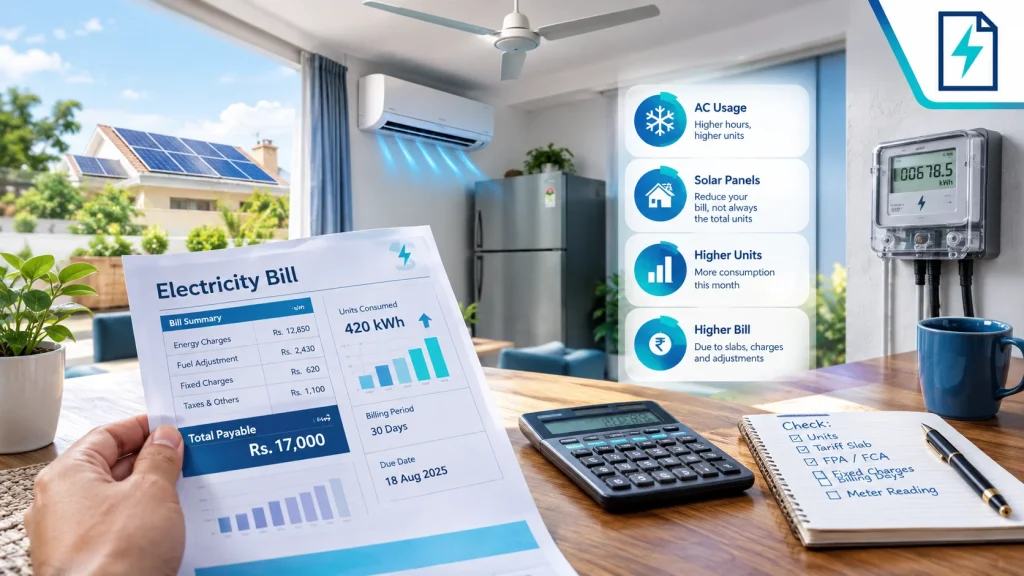
MEPCO’s billing documentation distinguishes actual consumption from estimated consumption and states that estimated consumption may be used in cases such as defective meters. It also identifies the reading date, billing period and total units consumed as important bill fields.
If the bill was prepared using an estimated reading, the units may not match what you actually consumed during that period.
An easy check is to:
- Read the current meter yourself.
- Photograph the meter display.
- Compare it with the current reading printed on the bill.
- Check the previous reading.
- Calculate the difference between the two readings.
If your physical meter reading is substantially lower than the bill’s current reading, don’t ignore it. Keep the photograph and bill as evidence, then register your complaint on CCMS and track its status.
An FPA/FCA Adjustment Appeared on the Bill
Fuel-related adjustments can make a bill look confusing because the adjustment may relate to an earlier period of electricity generation costs rather than simply the electricity you consumed this month.
NEPRA publishes separate Fuel Charges Adjustment decisions for EX-WAPDA DISCOs, including MEPCO. In 2026, NEPRA has issued monthly FCA decisions for different preceding months, meaning an adjustment can appear on a later consumer bill.
Look at the bill’s adjustment or other-charges section rather than assuming the entire increase came from your household consumption.
MEPCO’s billing guidance specifically lists Fuel Adjustment charges among “Other Charges.”
So if your units are almost unchanged but the bill has jumped, check this section carefully.
Fixed Charges Changed Because of Your Sanctioned Load
Not every part of an electricity bill is based directly on units consumed.
Depending on the applicable tariff category, fixed charges can be connected with the connection’s sanctioned load or billing demand. NEPRA’s tariff terms define sanctioned load as the load authorized by the distribution company and define fixed charges separately from variable kWh-based charges.
This matters if your connection’s sanctioned load, tariff category or applicable fixed-charge structure has changed.
For example, a household can consume roughly the same number of units as last month but still receive a higher bill because another charge component has increased.
Check your bill for:
- Sanctioned load
- Tariff category
- Fixed charges
- Billing demand, where applicable
- Any recently changed connection details
Don’t assume that “same units = same bill.”
Your Billing Cycle Was Longer Than Normal
Check the previous reading date and current reading date.
A normal billing period is not necessarily exactly 30 calendar days every time. MEPCO’s tariff terms define a billing month as a period of 30 days or less under the stated general definition.
If your actual bill covers more days than the previous bill because of a reading or billing-date difference, your household may simply have had more days in which to consume electricity.
For example:
30 days × 8 units/day = 240 units
But:
35 days × 8 units/day = 280 units
That’s 40 additional units without changing your daily electricity habits.
When comparing bills, compare units per day, not just total units.
A quick calculation is:
Units consumed ÷ number of billing days = average daily consumption
This can reveal whether your electricity usage actually changed.
Your Electricity Meter May Be Faulty
A faulty meter deserves attention when the bill suddenly rises without a clear increase in appliance use.
Watch for signs such as:
- Units increasing unusually fast
- Consumption remaining high when the house is mostly empty
- A reading that doesn’t match the physical meter
- Sudden changes that don’t match previous months
- Repeated estimated readings
- Meter display or mechanical problems
Don’t immediately assume the meter is faulty, though. First switch off major appliances and observe whether the meter continues recording consumption. If the behavior looks abnormal, document the meter reading and register a complaint on CCMS — you can then track the complaint status.
MEPCO’s billing documentation also recognizes estimated consumption in cases involving defective meters, so a meter issue can affect both the reading and the eventual bill calculation.
Your 5-Minute MEPCO High-Bill Checklist
Before contacting MEPCO, check these seven items on your bill:
| Check | What to compare |
|---|---|
| Units | Current vs previous 2–3 bills |
| Meter reading | Printed reading vs actual meter |
| Billing dates | Number of days covered |
| Tariff slab | Did you cross a consumption threshold? |
| FPA/FCA | Is an adjustment included? |
| Fixed charges | Did the charge or sanctioned load change? |
| Meter behavior | Is consumption unusually high? |
Then calculate your approximate daily usage.
If last month’s bill was 180 units over 30 days and this month’s bill is 270 units over 30 days, your average increased from 6 units/day to 9 units/day. That’s a real consumption increase and is worth investigating around AC use, pumps and other high-load appliances.
If both bills are around 180–190 units but the rupee amount changes sharply, focus more closely on tariff rates, fixed charges, taxes and adjustments.
How to Check Your Bill More Closely
Once you have identified the number of units and billing period, use the MEPCO Bill Calculator to estimate the electricity cost and understand how consumption affects the bill.
Then compare the applicable tariff components with the latest MEPCO tariff rates. This is especially useful when your units have crossed a slab or the bill contains a separate adjustment.
The goal isn’t simply to find the biggest number on the bill. It’s to find which component changed.
FAQ Why Is My MEPCO Bill High?
Why is my MEPCO bill high this month?
The most common causes are higher electricity consumption, especially AC use, crossing a tariff slab, estimated meter readings, fuel-related adjustments, fixed charges, a longer billing period or a meter problem.
Why did my MEPCO bill increase when my units are the same?
If consumption is similar, check fixed charges, FPA/FCA or other adjustments, taxes and the tariff applicable to your connection. The rupee amount isn’t determined by units alone.
Why is my MEPCO bill high even though I didn’t use more electricity?
Compare the billing dates, tariff slab, fixed charges and adjustment sections. Also check whether the meter reading printed on the bill matches the actual meter.
What should I do if my MEPCO meter reading is wrong?
What are the current MEPCO tariff rates?
MEPCO tariff rates vary by consumer category and units consumed. Check the latest MEPCO tariff rates for current slabs, charges and applicable adjustments.
What is the most common reason for high electric bills?
Higher electricity usage, especially from ACs, is a common reason for a high bill. If you’re asking why is my MEPCO bill high, first compare your current units with previous months.
How much does a 200-unit electricity bill cost in Pakistan?
A 200-unit bill depends on the applicable tariff slab, taxes, fixed charges and adjustments. The final amount can therefore vary between billing periods.
How to calculate MEPCO bill?
To calculate a MEPCO bill, check your units, applicable tariff, fixed charges, taxes and adjustments. A MEPCO bill calculator can help estimate the total amount.
Final Check
Before assuming there’s an error, compare units, dates, tariff slab, meter reading, fixed charges and adjustments. Those six checks usually narrow down the reason for a surprisingly high MEPCO bill much faster than looking at the final payable amount alone.
خلاصہ
اگر آپ کا میپکو بل اچانک زیادہ آیا ہے تو پہلے پچھلے بلوں سے یونٹ، میٹر ریڈنگ اور بلنگ کی تاریخوں کا موازنہ کریں۔ زیادہ بل کی عام وجوہات میں اے سی کا زیادہ استعمال، ٹیرف سلیب کی تبدیلی، 200 یونٹ کی حد عبور کرنے سے محفوظ درجہ ختم ہونا، تخمینی (EST) ریڈنگ، ایف پی اے ایڈجسٹمنٹ، فکسڈ چارجز، بلنگ سائیکل کا طویل ہونا یا خراب میٹر شامل ہیں۔ اگر میٹر ریڈنگ غلط لگے تو میٹر کی تصویر لے کر CCMS پر شکایت درج کروائیں اور اس کی پیروی کریں۔ اپنا بل چیک کرنے اور یونٹ کا حساب لگانے کے لیے اسی ویب سائٹ کا بل چیکر اور کیلکولیٹر استعمال کریں۔
Disclaimer: mepcobillinfo.online is an independent informational website and is not affiliated with MEPCO or PITC.